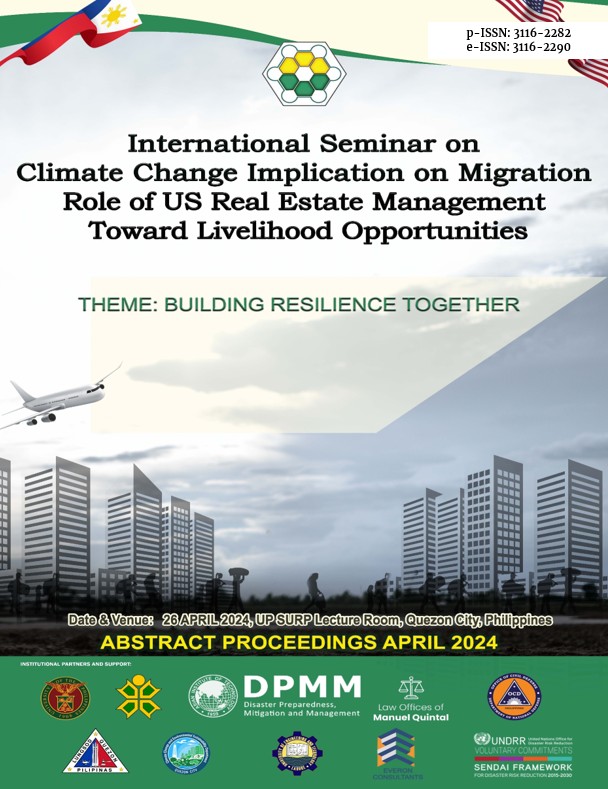
EVENT PROCEEDINGS

Title: International Seminar on Climate Change Implication on Migration Role of US Real Estate Management Toward Livelihood Opportunities.
e-ISSN: 3116-2290
p-ISSN: 3116-2282
Website: https://planades.org/proceedings/
Country: Philippines
Publication Year: 2024
TITLE: International Seminar on Climate Change Implication on Migration Role of US Real Estate Management Toward Livelihood Opportunities
There has been a growing attention on the impact of climate change on human migration among scholars and policymakers. Climate change has been determined to be a key driver of mobility in the Agenda for Humanity, the 2016 United Nations Summit for Refugees and Migrants, and the Global Compact for Migration and the Global Compact on Refugees. Along with these anomalies, there are other well-known impact of climate change phenomenon that has ignited this migration due to global temperatures rise, extreme weather events that has become more frequent and intense, leading to displacement and migration of populations. Most of the European countries have crafted policies to accommodate climate change-related migrations. The United States, with its vast real estate industry can contribute in resolving similar challenges by playing a significant role.
This international seminar aims to explore the implications of climate change on migration and examine how the US real estate management sector can contribute to creating livelihood opportunities for affected populations. Further, along with migration issue, this seminar will also cover climate change- related impacts to the communities that include among others are lack of precipitation, intensive heat episodes, change in weather pattern are leading toward El Niño, drought, illnesses, and health stresses to the vulnerable communities. In addition, disaster risk reduction and climate change adaptation mainstreaming in the urban and rural planning process will also be tackled in this seminar.
The participants will be sharing their works, research, and good practices in the seminar for direct and indirect stakeholders who can learn and utilize these practices in their decision making towards resilient societies.

Title: International Conference on the Nexus of Cultural, Psychosocial, Spatial Form, Climate Change Impact, Disaster Risk, and Sustainable Development Issues (IC-NCPSCDS).
e-ISSN: 3116-5524
p-ISSN: 3116-5516
Website: https://planades.org/proceedings/
Country: Philippines
Publication Year: 2025
TITLE: INTERNATIONAL CONFERENCE ON THE NEXUS OF CULTURAL, PSYCHOSOCIAL, SPATIAL FORM, CLIMATE CHANGE IMPACT, DISASTER RISK, AND SUSTAINABLE DEVELOPMENT ISSUES (IC-NCPSCDS)
The 21st century presents a complex array of interdependent challenges that demand urgent and innovative responses. From the rapid pace of urbanization to the intensifying impacts of climate change, these challenges are further compounded by entrenched cultural dynamics and psychosocial vulnerabilities. Addressing these issues in isolation is no longer feasible; instead, they call for integrated, transdisciplinary approaches that consider ecological, spatial, psychological, and cultural dimensions in tandem.
Across both urban and rural environments, climate change is exacerbating the frequency and severity of natural hazards—ranging from floods and heatwaves to droughts and wildfires—thereby increasing human exposure and vulnerability, particularly in socio-economically and environmentally marginalized areas. These vulnerabilities are often embedded in spatial configurations, such as informal settlements or poorly planned urban expansion, which are themselves shaped by longstanding cultural norms and development practices. Moreover, the psychosocial impacts of disasters—such as trauma, displacement, identity loss, and the erosion of community cohesion—highlight the importance of integrating mental health and well-being into resilience planning.
In many regions, the dual pressures of climate change and urbanization interact with fragile governance systems and deeply rooted cultural identities, influencing the ways communities perceive and respond to risk. Cultural heritage and traditional knowledge, often overlooked in formal planning processes, play a critical role in shaping community resilience and adaptive capacity. Therefore, sustainable development cannot be achieved without acknowledging the interplay between spatial form, cultural identity, and psychosocial health, particularly in contexts prone to climate-related and disaster risks. This international conference seeks to create an inclusive platform for dialogue, learning, and knowledge exchange at the intersection of these critical domains: cultural heritage and identity, psychosocial well-being, spatial and urban form, climate change impacts, disaster risk, and pathways toward sustainability transitions. The goal is to bridge existing gaps across academic disciplines, governance structures, and community perspectives in order to foster more resilient, inclusive, and context-sensitive development strategies.


